Lucid AI API costs: budget for accepted work, not just tokens
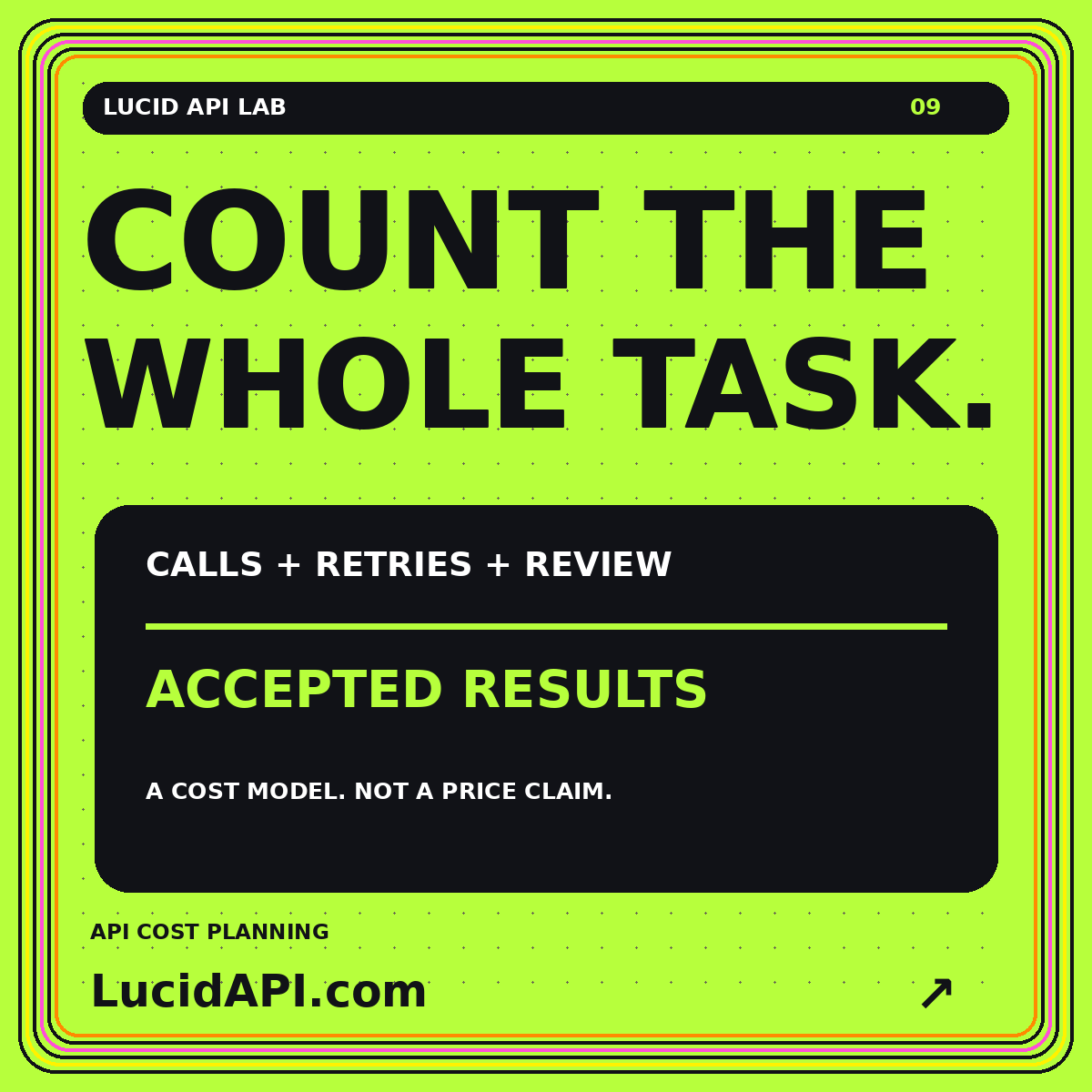
Use a transparent hypothetical model to estimate inference, retries, review, storage, and multi-step workflow costs without invented vendor prices.
THE DEVELOPER’S FIELD NOTES
Explore ten practical field guides on lucid APIs, dream records, model evaluation, and bounded agents. Read a complete guide, follow a topic, or take the series from contract to test suite.
10 LONG-FORM GUIDES / 2024–2026
Use a transparent hypothetical model to estimate inference, retries, review, storage, and multi-step workflow costs without invented vendor prices.
Choose between a fixed workflow and model-directed actions, then define tool permissions, approval points, stop rules, and recoverable state.
Build a layered test suite that checks schema meaning, ownership, model adapters, asynchronous state, and user-visible outcomes.
A practical threat-modeling guide for journal records, generated summaries, exports, background jobs, and administrative access.
Create a small, repeatable evaluation set for faithful summaries, structured extraction, uncertainty handling, and operational fit.
An evidence-aware event model for teams documenting dream reports, experimental cues, observations, and uncertain classifications.
Separate extraction, summary, and reflection so generated text remains grounded in the account the user actually provided.
Design a recoverable model-integration boundary with bounded retries, explicit job states, output validation, and useful telemetry.
A practical starting point for separating dream records, AI transformations, and agent actions into an understandable API.
Model dream reports, revisions, consent choices, and generated annotations without turning missing information into false certainty.