Lucid AI API costs: budget for accepted work, not just tokens
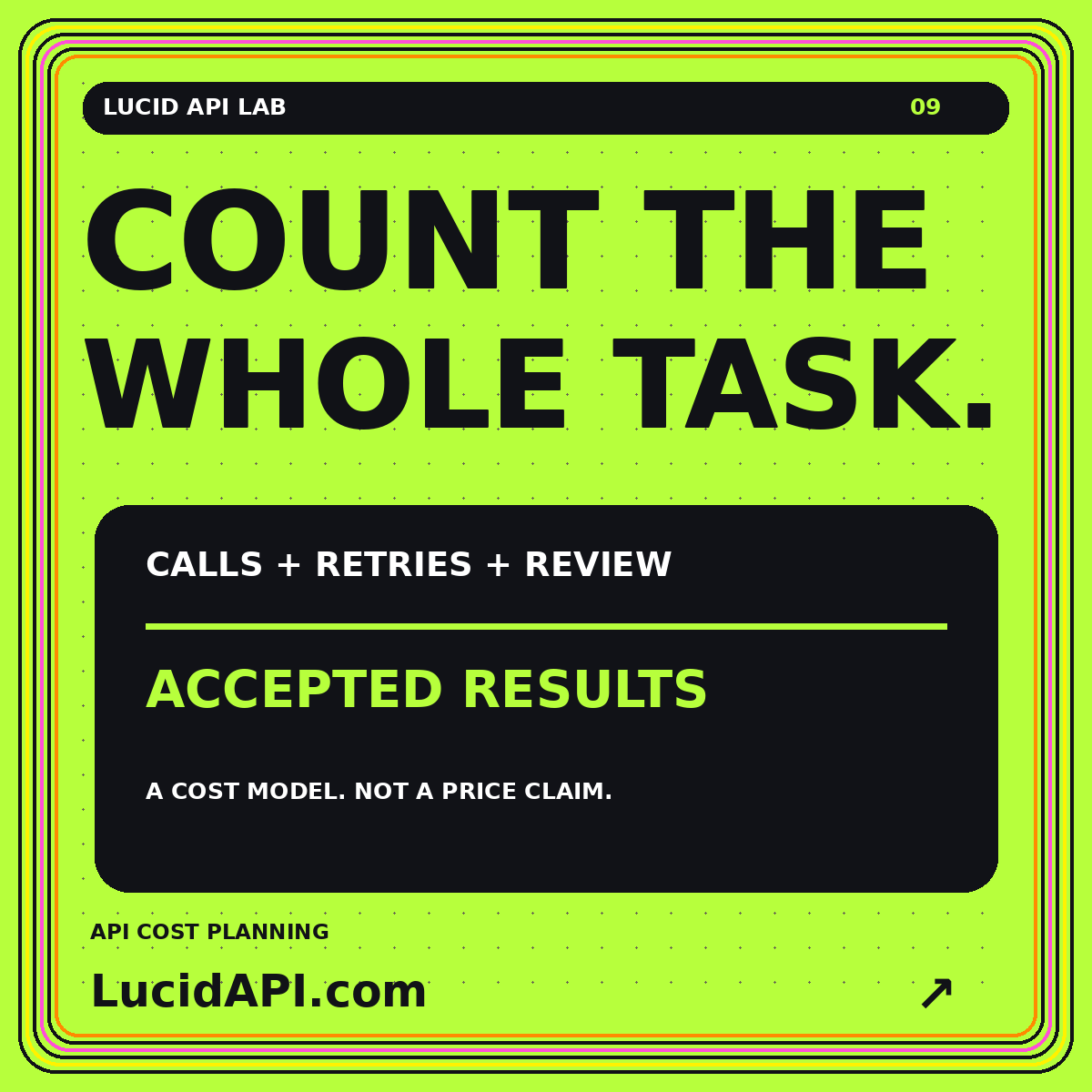
Use a transparent hypothetical model to estimate inference, retries, review, storage, and multi-step workflow costs without invented vendor prices.
LUCID API LAB / TOPIC THREAD
Evaluate a configuration in context.
The AI models thread covers choosing and evaluating a model configuration for a defined task. It includes faithful summaries, application-specific test sets, bounded agents, and cost planning. The focus is not a brand ranking or a claim that one model is universally best.
Write the task contract before comparing outputs. Preserve the complete configuration, inspect supported details, and separate content failures from formatting and operational measures. A new prompt or different source selection changes the experiment even when the model name stays the same. Use the summary workflow as a concrete starting task and keep review criteria visible as the application grows.
Field guides following
the ai models thread.
Use a transparent hypothetical model to estimate inference, retries, review, storage, and multi-step workflow costs without invented vendor prices.
Choose between a fixed workflow and model-directed actions, then define tool permissions, approval points, stop rules, and recoverable state.
Create a small, repeatable evaluation set for faithful summaries, structured extraction, uncertainty handling, and operational fit.
Separate extraction, summary, and reflection so generated text remains grounded in the account the user actually provided.