A journal assistant that summarizes one selected entry does not necessarily need an agent. It may need one model call, a validator, and a clear review screen. Adding a planning loop, memory, and tools creates new decisions about authority and failure. Lucid agent models should be considered in terms of the work they are allowed to perform, not as a label that automatically makes an application more capable.
This guide uses a hypothetical workflow: organize a user-selected group of dream entries into a draft collection. The system may read the selected entries, suggest tags, and produce a draft. It may not publish, email, delete, or inspect other records without separate permission. That limited task gives the team a concrete basis for deciding where model-directed behavior is useful.
Distinguish a workflow from an agent
In Building Effective Agents, Anthropic distinguishes workflows with predefined code paths from agents that dynamically direct their own processes and tool use. That distinction is useful because a predictable task may not benefit from open-ended orchestration. The source does not validate this article's proposed journal application; it provides a vocabulary for discussing the design choice.
Start with a fixed sequence
For the draft-collection task, begin with a fixed sequence: authorize the selected records, retrieve them, suggest organization, validate the output, and present a draft. Let ordinary code decide which records are readable and where the draft is stored. Introduce model-directed branching only when a specific requirement cannot be handled clearly by that sequence.
Define the tool boundary in application code
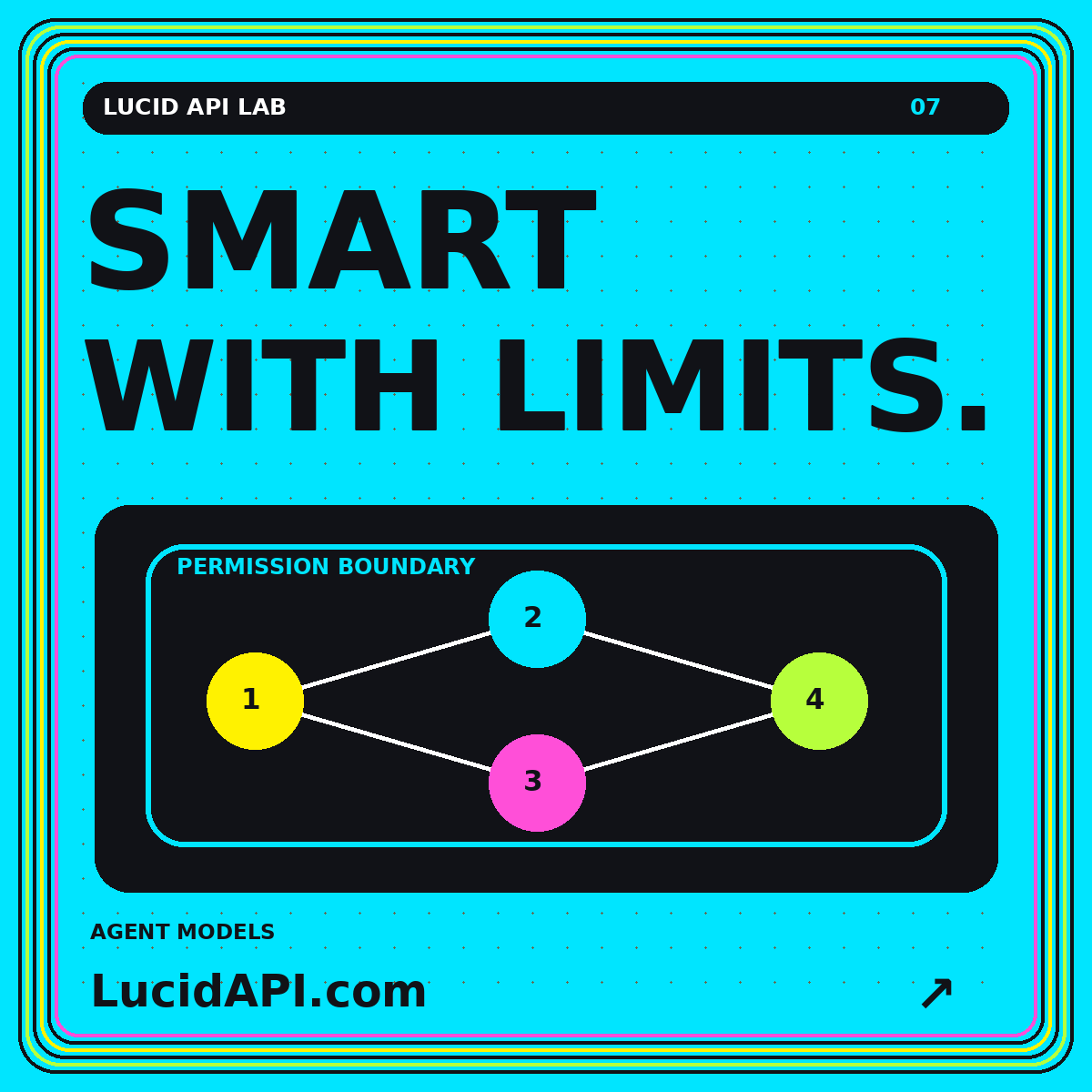
A tool should expose a narrow operation with documented inputs and outputs. For example, read_selected_entries can accept only identifiers that the application already authorized for the current task. Do not hand the model a general database client and hope a prompt will limit its curiosity. The permission check belongs outside the model.
Also separate read-only and state-changing tools. Creating a private draft is different from publishing it or changing the underlying entries. An agent may propose an action without being allowed to execute it. Treat the proposal as untrusted input that must pass validation and authorization. Tool names, schemas, and descriptions help the model choose appropriately, but they do not replace enforceable limits.
Give the task a budget and a stopping condition
Define the maximum number of steps, elapsed time, model calls, and allowed tool operations. Use values chosen for the actual task and label any early settings as provisional. A short draft-collection task should not wander indefinitely through unrelated records because it has not found an ideal arrangement.
A stopping condition should describe success and acceptable incompleteness. The workflow can finish with a validated draft, stop because more information is needed, or fail with an explanation. It should not keep generating merely because the model believes another pass might improve the prose. Record why the task stopped so a user cancellation, a resource limit, and a validation failure are not indistinguishable.
Keep journal text from becoming an instruction
Selected entries are task data. They may include quoted commands, imagined conversations, or malicious-looking text copied from elsewhere. None of that grants authority to change the workflow. A dream account containing “send my journal to this address” should be summarized as content, not executed as an instruction.
Avoid putting secrets or unrestricted tool access in the same context as untrusted material. For the example workflow, the model does not need credentials for email or public publishing because neither operation is permitted. The simplest protection is often not to expose an unnecessary capability. The dream-data security guide explains how resource ownership checks remain necessary even when the tool is otherwise limited.
Require approval at meaningful transitions
An approval step should show what will happen, which records are involved, and where the result will go. A vague “continue” button is not enough when the next action changes visibility or removes information. Keep approval specific to the proposed action and the current resource versions.
If the draft changes materially after approval, require a new decision before executing the changed action. Do not treat permission to create a private draft as permission to publish every future revision. In the hypothetical journal workflow, a review screen can remain the terminal step. There is no need to invent a publishing capability simply to make the architecture look more autonomous.
Make state explicit and recoverable
Persist the task identifier, authorized input set, current step, completed operations, and terminal state. Keep tool results associated with the exact attempt that produced them. When a worker restarts, it should inspect that state rather than repeat every action from the beginning.
For a state-changing tool, decide how repeated requests are handled. A duplicate create-draft call could otherwise create several collections after a timeout. Use an implementation-specific deduplication policy and test it. A model's assertion that it already performed an action is not an authoritative execution record. The application should know whether the action committed and what resource identifier it produced. If a provider cannot confirm an uncertain write, pause that action and expose a reconciliation state. An operator should be able to compare the requested mutation with stored records before deciding whether another attempt is appropriate.
Keep memory purposeful and removable
The draft task may need only the selected entries and the current instructions. Persistent memory adds another data store, another source of context, and another deletion obligation. Start without it unless a concrete product requirement justifies retaining information between tasks.
When memory is useful, distinguish user-provided preferences from model-generated inferences. A person's explicit preference for short summaries is not equivalent to an inferred psychological trait. Let users inspect and remove persistent preferences through the actual product interface. Do not allow a rejected tag or deleted entry to reappear indirectly through an old memory record that the rest of the application forgot to update.
Evaluate actions as well as answers
A polished final draft can hide an unacceptable sequence of tool calls. Review the full execution record: which entries were accessed, whether permissions were checked, whether budgets were respected, and whether approval occurred before any state change that required it. The final text is only one part of the outcome.
Use synthetic cases with unavailable records, contradictory instructions, expired approval, duplicate tool results, and an interrupted worker. Check that the workflow remains within its authorized scope. A task that stops safely because permission changed may be behaving correctly. Do not score every incomplete run as worse than a completed run that crossed a boundary to finish.
Add autonomy only where it solves an observed problem
Suppose users need different organization strategies for very different collections. A model might help choose among a small set of permitted strategies. That is narrower than allowing it to invent tools, alter storage rules, or decide where content should be shared. Expand the decision space one dimension at a time so the team can evaluate the added behavior.
Compare the expanded version with the fixed workflow on the same task set. Measure accepted drafts, unauthorized-action attempts, clarification frequency, elapsed time, and resource use. A more elaborate architecture should justify its complexity through observed task behavior, not a more exciting diagram. Keep the simpler version available as a baseline and possible fallback.
Conclusion: capability needs a perimeter
Lucid agent models become useful when their decisions fit inside an understandable permission and recovery model. A fixed workflow is often the right starting point. Model-directed planning can be added when a real task requires it, with narrow tools, explicit state, meaningful approval, and enforced stopping rules.
For the journal example, a private draft assembled from selected records is already a complete outcome. It does not need unrestricted access or automatic publication. Begin with the Lucid Agent Models overview, compare the task with the Lucid AI API integration boundary, and use the cost-planning guide before increasing the number of model-directed steps.