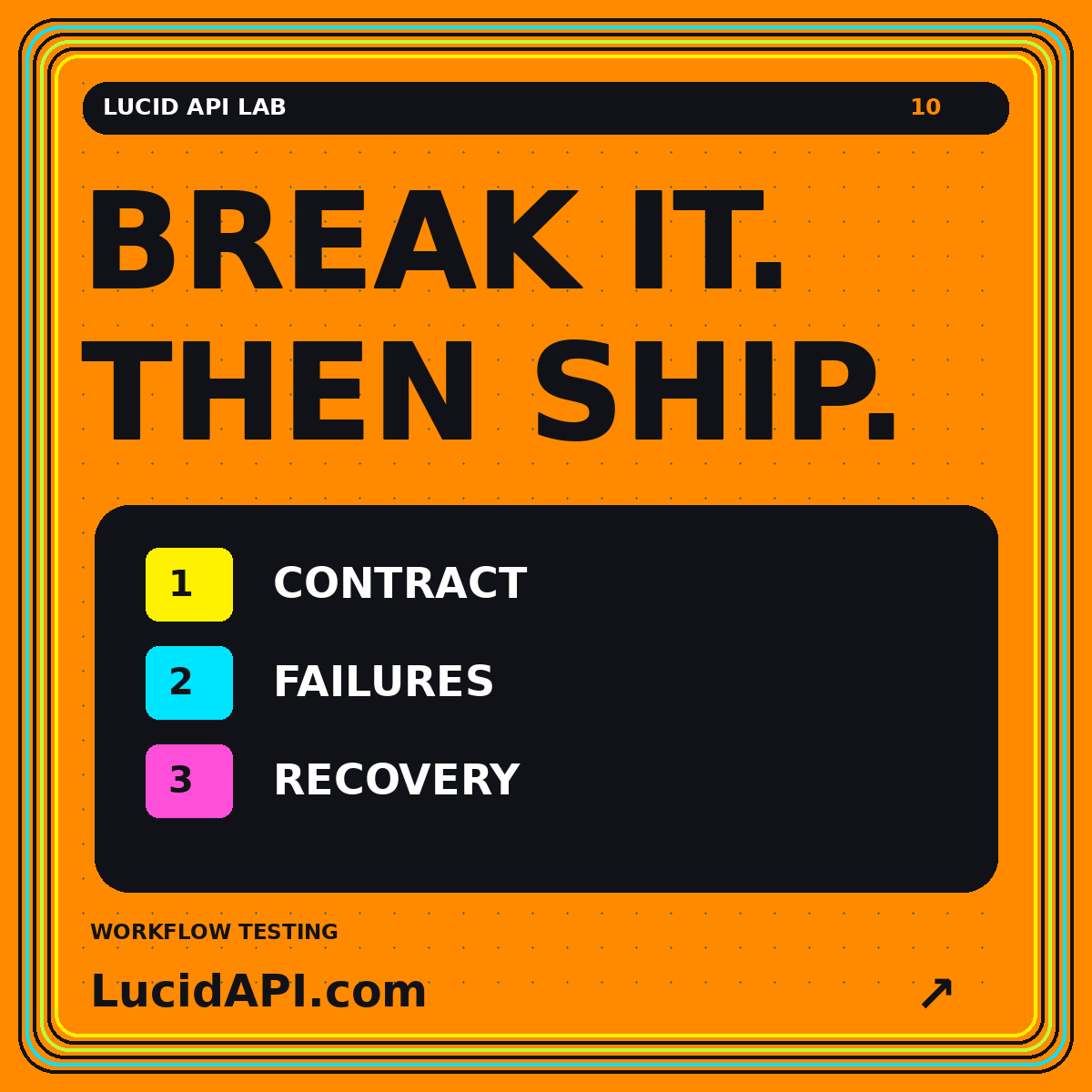
A useful API test suite does more than confirm that a valid request returns a successful status. It checks what happens when permission changes, a response arrives late, a source entry is revised, or a provider returns malformed output. For Lucid API workflows, those cases matter because a generated result is connected to a person's record, a specific transformation, and a particular moment of authorization.
This guide proposes a layered test strategy for an application you build. It does not claim that example routes on LucidAPI.com are running services. Begin with synthetic journal entries and a fake model provider. That gives the team repeatable control over ordinary outcomes and deliberately difficult failures before any test depends on private data or paid inference.
Turn the contract into observable promises
Read each operation description and write down what a client should observe. A save operation should preserve the authorized user's text. A summary operation should identify its source revision. A cancelled job should not later publish a result as if cancellation never happened. These statements are stronger test targets than simply checking whether a helper function was called.
Include promises about absence. An unauthorized caller should not receive the entry body in an error, and a failed model transformation should not remove the original journal. Negative assertions help catch leaks and unwanted side effects. Keep the Lucid API architecture guide beside the test plan so changes to the contract produce corresponding changes to the tests.
Use a test framework for organization, not authority
Python's unittest documentation describes test cases, fixtures, suites, and assertions. Those mechanisms help organize repeatable checks and report failures. Passing a collection of tests does not establish that the collection covers every relevant behavior; the design of the cases remains the team's responsibility.
Make the failed promise easy to identify
A small unit test can check a pure transformation such as mapping a recognized state to a display label. Keep such tests independent of network access and real credentials. Use descriptive names that explain the expected behavior. A failure called test_cancelled_job_cannot_publish tells the reviewer more than test_case_17, particularly when the same suite is used months after its author wrote it.
Create fixtures that preserve uncertainty
A fixture is a known input used to exercise behavior. Build synthetic entries with unspecified lucidity, unknown experience dates, multilingual text, corrections, and empty optional annotations. Include an entry whose text contains instruction-like language, such as a quoted request to ignore the rules. That text should remain data throughout the summarization path.
Keep the fixtures small enough to understand by inspection. A giant file copied from a real export can make a test look realistic while hiding the specific reason it exists. Add a short description explaining each fixture's purpose and expected meaning. If a later developer replaces unspecified with false to simplify a test, the description should make clear that the change destroys the case being tested.
Test schema rules and semantic relationships
Schema tests check required fields, allowed types, enumerations, and size limits. Semantic tests check relationships that may require application logic, such as whether a generated result references a valid source revision or whether the requester owns the record. Both are necessary because a document can be structurally valid while referring to the wrong person's entry.
Use pairs of closely related examples: one allowed and one rejected for a single clear reason. A missing optional field should not fail merely because most fixtures include it. An unexpected field should receive the behavior the contract specifies rather than being silently forwarded upstream. The journal-schema article gives concrete distinctions between absent, empty, and unknown values to preserve in these tests.
Use a fake provider to control difficult outcomes
A fake adapter can return a valid response, malformed JSON, an unsupported field, a timeout, or a deliberately delayed result. Configure it to record attempted calls without storing sensitive data. This lets tests verify retry counts and terminal states without waiting for a real provider to fail in a particular way.
Do not make the fake unrealistically forgiving. It should reject inputs that the real adapter would reject and expose meaningful operational states. Keep a separate integration test for the actual provider contract, using authorized synthetic data and an explicit budget. Unit tests should not unexpectedly create billable calls because a developer forgot to set an environment variable.
Exercise the uncertain timeout window
One of the most informative cases is a timeout after upstream work has been accepted but before the application receives confirmation. The test should check whether the system inspects existing state or resubmits under its documented deduplication policy. A blind retry may create duplicate work even when the final interface displays only one result.
Assert the logical outcome as well as the number of attempts. If two transport attempts map to one intended transformation, the application should retain that relationship. A successful test should also confirm a bounded stopping point when the outcome cannot be recovered. An endlessly pending job is not a reliable alternative to a duplicate result; it is a different unhandled failure.
Test permission and deletion races
A workflow may be authorized when queued and no longer authorized when it completes. Simulate deletion, revoked sharing, and a changed source revision while the fake provider is still running. Verify that the worker checks the current state before committing or exposing the result. The expected behavior should be explicit for each case.
Also test cached results and exports. A main entry route can correctly deny access while a download route still exposes the same information. Follow the data-flow map through every derivative rather than testing only the most visible endpoint. The security guide identifies access paths that are easy to overlook when a feature evolves from one page into several background processes.
Keep exact assertions for deterministic behavior
Identifiers, permissions, field presence, state transitions, and budget limits can often be checked exactly. Generated prose usually needs a different approach. Do not require one exact sentence when several faithful summaries are valid, and do not accept any sentence merely because it is nonempty. Use a task-specific rubric for supported details, uncertainty, and prohibited additions.
Separate deterministic regression tests from model-quality evaluation. Store the configuration used for the evaluation and retain the evaluated outputs. That makes later comparisons interpretable without claiming that an external model will reproduce identical wording forever. A test suite should reveal whether the application kept its contract; an evaluation should reveal how well a particular configuration performed the content task.
Test the user-visible recovery path
An application can have correct internal states and still leave a user confused. Exercise the screen shown after a saved entry's optional summary fails. Check that the original remains readable, that the status is accurate, and that any retry action is available only when it can actually work. A disabled or endlessly spinning control should not be the only explanation.
Test keyboard navigation, focus after opening or closing menus, narrow-screen layouts, and long text. For a static documentation site, check every internal link, image, canonical URL, and feed entry without assuming that a successful homepage render proves the rest of the site works. Keep functional tests distinct from visual review; both can find problems that the other misses.
Conclusion: test the promise at the boundary
A strong Lucid API test strategy connects the written contract to observable behavior. It uses small fixtures, controlled failures, resource-specific authorization checks, and explicit asynchronous states. It also distinguishes exact application behavior from the variable quality of generated language.
Start with one complete workflow and a fake provider. Test the timeout window, source revision changes, and deletion before expanding the feature set. Keep failures reproducible and explain what each fixture is protecting. Return to the Lucid API overview when a test reveals an ambiguous promise; improving that promise is often more valuable than adding another success-only assertion.