Lucid AI API integration: timeouts, retries, and results you can trust
Design a recoverable model-integration boundary with bounded retries, explicit job states, output validation, and useful telemetry.
03 / THE INFERENCE BOUNDARY
Put a deliberate boundary between your application and model inference: authorized input, constrained output, recoverable jobs, and a result worth showing.
Authorize the input
Validate the output
Bound the work
A Lucid AI API design connects an authorized task to a selected model configuration. It should not let provider-specific request details define the entire product. Start with one transformation, such as producing a short source-grounded summary from one journal revision.
The application decides which data may be sent and which operations are permitted. The model produces a candidate result. Validation and user-facing review determine what happens next. This separation makes it possible to change a provider without quietly changing the ownership and safety boundaries around the task.
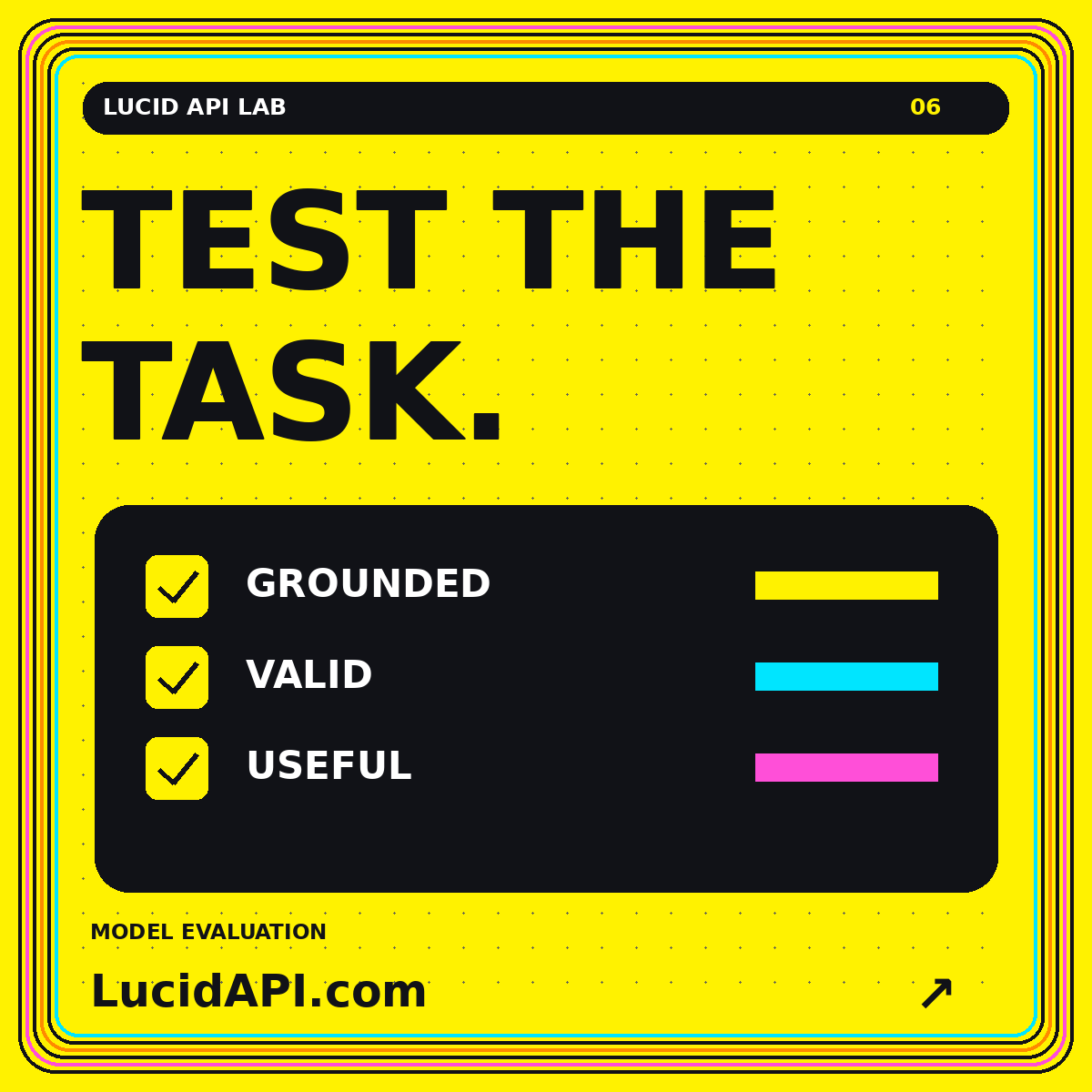
A completed network request can still return unusable content. Check structure, required fields, supported values, and task-specific requirements before displaying generated text. For summaries, that includes preserving important uncertainty and avoiding unsupported additions to the source account.
Record transport success, validation outcome, and content acceptance separately. A fast response that fails the task is not a successful user outcome. The Lucid AI Model guide shows how to make this evaluation more explicit than a preference for fluent prose.
Keep authentication, provider request formatting, response parsing, and error translation in a small integration layer. Do not imply that every provider supports identical context limits, retention terms, cancellation, or deduplication. Verify each capability in the selected service's actual documentation before relying on it.
Assign a logical request identifier before making upstream calls. Associate every attempt with that request and give the job explicit states. A client timeout means the client stopped waiting, not that computation necessarily stopped. Cancellation, retry, and source deletion each need a defined outcome.
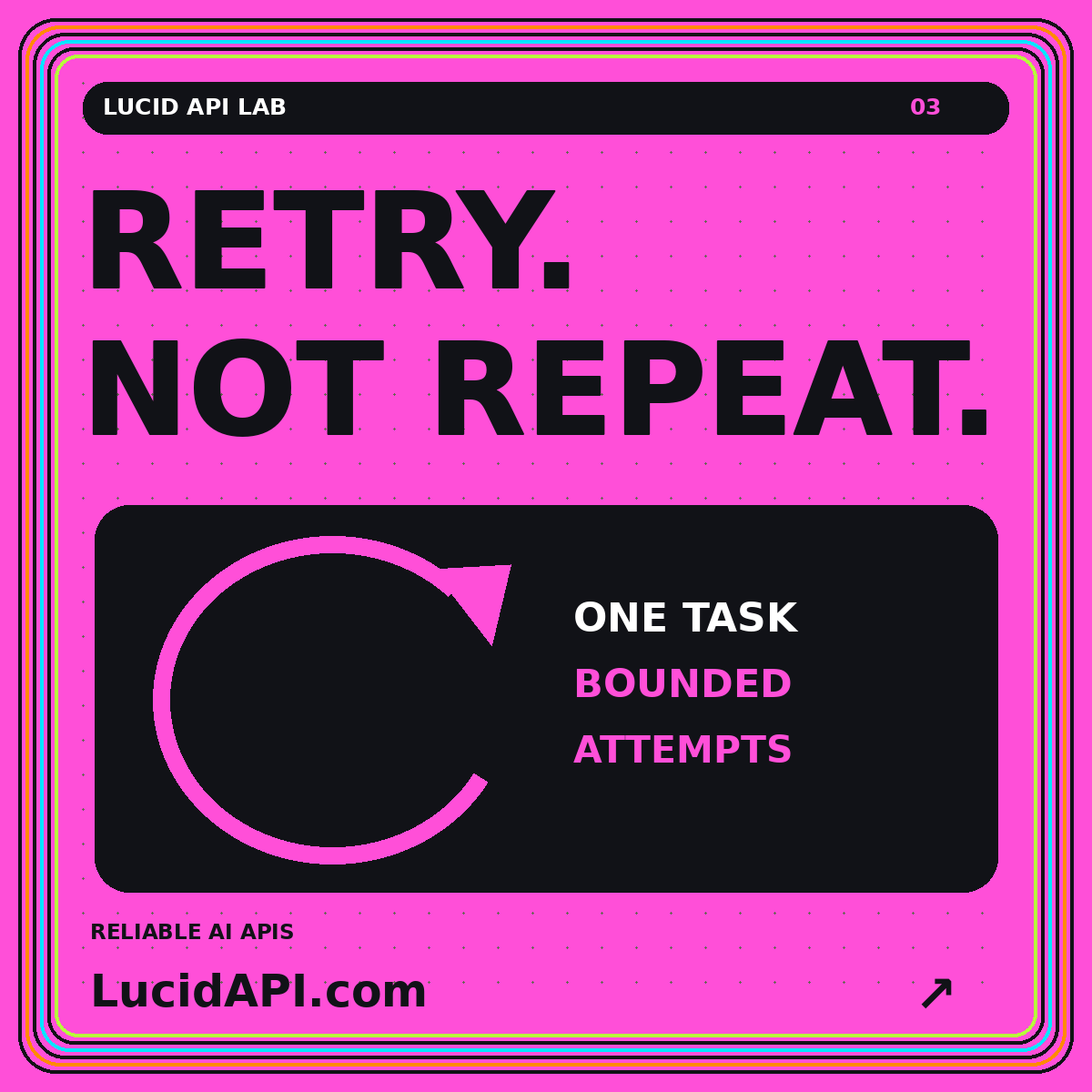
Use bounded retry policies for eligible failures and preserve the original journal when optional processing fails. A saved entry should not depend on the continuing availability of a model provider. For delayed work, recheck authorization and source revision before publishing the result.
Track input and output usage, repeated attempts, validation repairs, and any permitted tool calls. Compare cost per accepted result rather than only cost per network call. The cost-planning article uses clearly hypothetical rates to show the arithmetic without presenting invented service prices.
LucidAPI.com provides independent design material, not hosted inference or API-key provisioning. Production credentials do not belong in public static JavaScript. An operational application needs an appropriate protected execution environment and its own access controls. Use this resource to plan that architecture; do not mistake a static example for an available backend service.
FROM THE LUCID API LAB
Design a recoverable model-integration boundary with bounded retries, explicit job states, output validation, and useful telemetry.
Use a transparent hypothetical model to estimate inference, retries, review, storage, and multi-step workflow costs without invented vendor prices.
Create a small, repeatable evaluation set for faithful summaries, structured extraction, uncertainty handling, and operational fit.