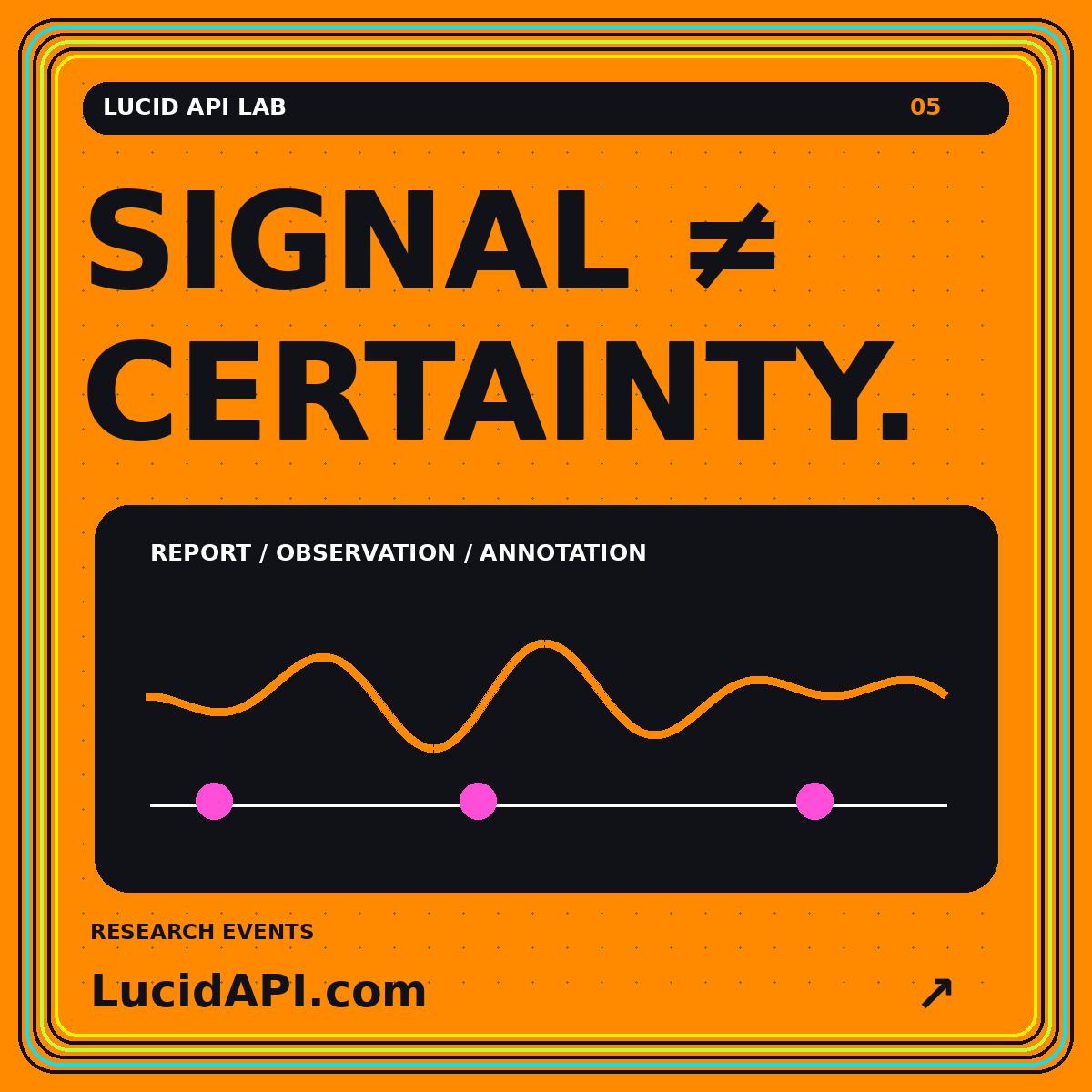
A phrase such as “lucid dreaming API” can sound like a direct connection to a dream. An engineering specification needs more precise language. The interface might carry a person's report, a device event, an experimenter's annotation, or a later interpretation. Those records can be related without being equivalent. A useful design keeps the origin and limits of each record visible.
This article concerns data architecture, not a method for inducing lucid dreams or instructions for running a human-subject experiment. It does not describe a validated device or a hosted research service. The goal is narrower: show how an implementation can represent experimental and self-reported information without turning an uncertain observation into an unsupported claim about a person's experience.
Begin with what research actually established
In a 2021 study described by Northwestern University's research team, researchers used confirmed REM sleep recordings and predefined signals to communicate with some dreaming participants. Participants could sometimes answer simple questions through eye movements or facial-muscle responses. This was a controlled research finding, not evidence that an ordinary text API can read or replay dreams.
Preserve the steps behind the finding
For software design, the useful lesson is the importance of distinct evidence types. A question was presented, a response was observed, and researchers interpreted that response within a protocol. An event stream should preserve those separate steps. Do not compress them into a single field named dream_content that suggests the system directly captured the subjective experience itself.
Name events by what happened
Choose event types that describe observable or reported actions. Examples for a proposed data model include cue_presented, device_sample_received, participant_report_added, and annotation_recorded. These names do not assume that a cue was perceived or that a detected movement had a particular meaning. Interpretation belongs in a related record with its own author and basis.
Avoid event names that imply more certainty than the collection process supports. A device output labeled lucid_detected might really be a classifier estimate under a specific configuration. Preserve that fact in the name or accompanying fields. Clear naming gives downstream developers a chance to keep the distinction intact rather than inheriting an overconfident label from the original producer.
Give time more than one field
A device event can have an occurrence time, a reception time, and a later annotation time. Those are different moments. A record uploaded after a connection returns should not appear to have happened at upload time. Preserve the timestamp as supplied, its time zone or offset when known, and any clock-quality information the collection system actually provides.
Do not invent precision. A participant's report that an event happened “during the night” should not be converted into an exact second. A source clock with uncertain synchronization should carry that uncertainty. For ordering, consider a source sequence number alongside timestamps. Sequence can reveal missing or repeated records even when clocks are imperfect, provided its meaning is documented for that source.
Separate raw observations from annotations
Keep a device's observation record distinct from an experimenter's label and a participant's later account. Each can point to a shared session and relevant interval. If an annotation changes, create a revision rather than modifying the underlying observation to match the newer interpretation. That separation supports later review without pretending the first label was never present.
For example, an event can record that a signal was received at a particular source sequence. A separate annotation can record that a reviewer considered the signal interpretable under a named protocol. Neither record should automatically populate a person's journal with a story about what they dreamed. The Lucid Dream API guide describes how self-reported accounts should remain separately identified.
Record protocol and configuration context
A meaningful research event often depends on the collection procedure. Keep a protocol identifier, configuration version, device or software version where appropriate, and a way to identify who or what produced an annotation. A naked numeric value is difficult to interpret when its units, filtering, or reference conditions are missing.
Document which configuration changes create a new session segment. If the event producer restarts or changes its detection settings, downstream software should not assume a continuous series with identical conditions. Avoid exposing personal identities simply to make provenance convenient. Pseudonymous study identifiers and carefully controlled mappings can support an application design without embedding direct contact information in every event payload.
Treat delivery behavior as part of meaning
A networked event stream can produce late, duplicated, or out-of-order records. Decide whether the consumer deduplicates by an event identifier, source sequence, or another documented key. Preserve the original event identity through re-delivery. Generating a new identity every time the sender retries makes it harder to distinguish a new observation from a repeated message.
Define what a missing sequence means and how the interface represents a gap. Do not fill gaps with synthetic observations unless they are explicitly marked as derived. A chart that visually joins two distant samples can imply continuity that the source did not provide. The display and the API should both make missing information inspectable rather than smoothing it away for presentation.
Keep control operations out of passive data access
Reading recorded events and controlling equipment are different capabilities. A passive data API should not accidentally become a route for changing cues or device behavior. If a separate control interface exists in an authorized research implementation, it needs its own permission model, operational limits, and supervision appropriate to that setting.
For an educational prototype, use recorded synthetic events rather than live control. That lets developers test sequencing, schemas, and visualization without implying that the software is ready for use with sleeping participants. Label simulated records at the source and keep that label through exports. Mixing simulated and observed records without an origin field can undermine later analysis even when the original intention was harmless testing.
Review claims at every interface boundary
A cautious source system can still feed an overconfident dashboard. Review the language in API fields, charts, tooltips, exports, and marketing copy. If the API returns an estimate, the chart should not relabel it as confirmation. If an annotation is preliminary, a download should not silently remove that status.
Give downstream developers concise definitions and examples of inappropriate inference. For instance, a cue event does not establish perception, and a self-report does not become an independent measurement merely because it is attached to sensor data. These distinctions are easier to maintain when the documentation includes a realistic example with ambiguity rather than only a perfectly aligned, success-only session.
Build a synthetic session for review
Create a short sample containing a cue, a delayed device record, a duplicated delivery, an annotation revision, and a later participant report. Ask a developer to reconstruct what is known and what remains uncertain. Then change one timestamp and remove one sequence number. The application should reveal those problems rather than producing an equally confident story.
Use this session to test exports and derived charts. A person reviewing an exported file should be able to identify simulated content, source identity, configuration context, and unresolved gaps without needing access to hidden application logic. Keep the workflow testing guide beside these fixtures so changes to the interface do not erase the distinctions the sample was designed to preserve.
Conclusion: evidence has a shape
A Lucid Dreaming API design is more credible when it describes exactly which information it carries. Reports, observations, cues, classifications, and interpretations each have their own origin and limits. Connecting them is useful; collapsing them into a claim of dream access is not.
Start with explicit event names, documented timestamps, independent annotations, and visible gaps. Keep passive access separate from equipment control and use synthetic examples for ordinary development. The Lucid Dreaming API topic page provides a concise reference map for those decisions, with an emphasis on preserving evidence rather than overstating what a signal can establish.