Lucid Dream AI: build faithful summaries without inventing meaning
Separate extraction, summary, and reflection so generated text remains grounded in the account the user actually provided.
04 / FAITHFUL TRANSFORMATIONS
Explore optional AI summaries, extracted details, and reflection prompts while keeping the original dream account primary and the person in control.
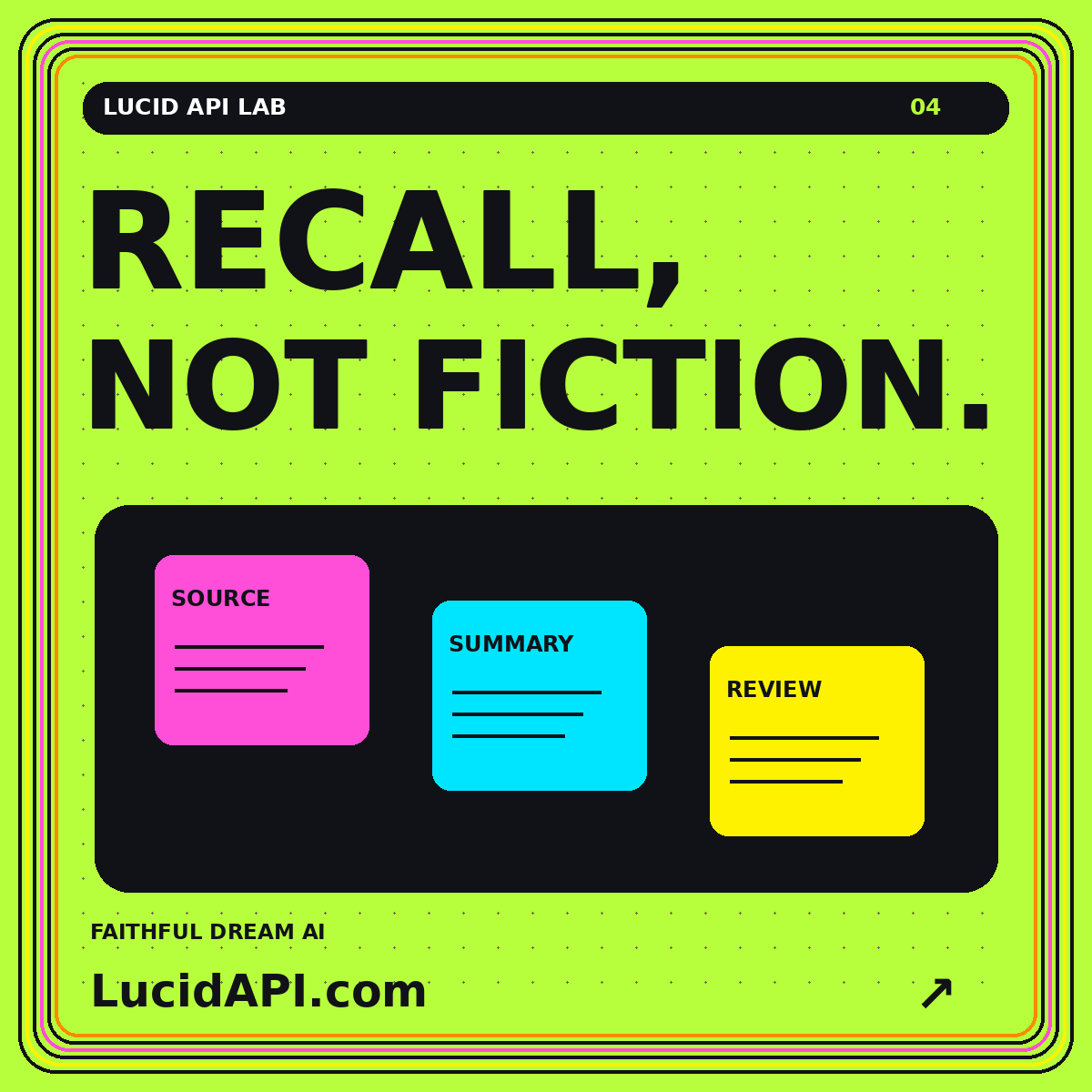
Ground every detail
Preserve ambiguity
Invite review
Lucid Dream AI can mean several different product ideas. Extracting reported objects is not the same as summarizing an account. Offering a reflection question is different again from generating a fictional continuation. Give each task its own name, input requirements, and review criteria.
For an initial feature, choose a source-grounded summary of a single authorized entry. Ask it to preserve meaningful uncertainty and avoid adding names, motives, locations, or conclusions that the account does not support. Treat the output as a candidate annotation, not a replacement for the user's writing.
A summary should identify the source entry and revision it describes. Preserve the original text so a person can compare the two. If the user edits the summary, record that it is now user-edited. If the source changes, do not automatically present the old summary as current.
Useful controls include keeping, correcting, and rejecting an annotation. Regeneration should not silently overwrite a person's edits. The dream-record schema guide explains the underlying relationships that make those interface choices possible.
An open question such as “What else do you remember about the place?” lets the person decide what to add. A question that assumes a particular fear or hidden motive introduces a conclusion without establishing it. Keep reflection optional and avoid presenting symbolic explanations as verified knowledge about an individual.
Use synthetic entries with incomplete recollections, uncertain identities, contradictions, multilingual text, and almost no remembered detail. Evaluate whether the result remains grounded, preserves qualifications, and admits insufficient information when appropriate.
Do not reward a smooth story simply because it reads well. Separate unsupported additions from omissions and formatting errors. A model can satisfy the output schema while still failing to preserve the meaning of the account. The model-evaluation article develops a repeatable rubric for these different dimensions.
Creative adaptation can be an enjoyable separate feature, but invented scenes should remain labeled as fiction. Do not write them back into a person's original account as recovered details. Similarly, repeated generated tags should not be presented as proof of a psychological trait.
The scope here is software design for organization and optional reflection, not diagnosis, validated dream interpretation, or direct access to a dream. For research signals and controlled observations, move to Lucid Dreaming API. Keeping these boundaries visible allows useful experimentation without claiming capabilities that the implementation has not established.
FROM THE LUCID API LAB
Separate extraction, summary, and reflection so generated text remains grounded in the account the user actually provided.
Create a small, repeatable evaluation set for faithful summaries, structured extraction, uncertainty handling, and operational fit.
Model dream reports, revisions, consent choices, and generated annotations without turning missing information into false certainty.