Lucid API architecture: start with the contract, not the model
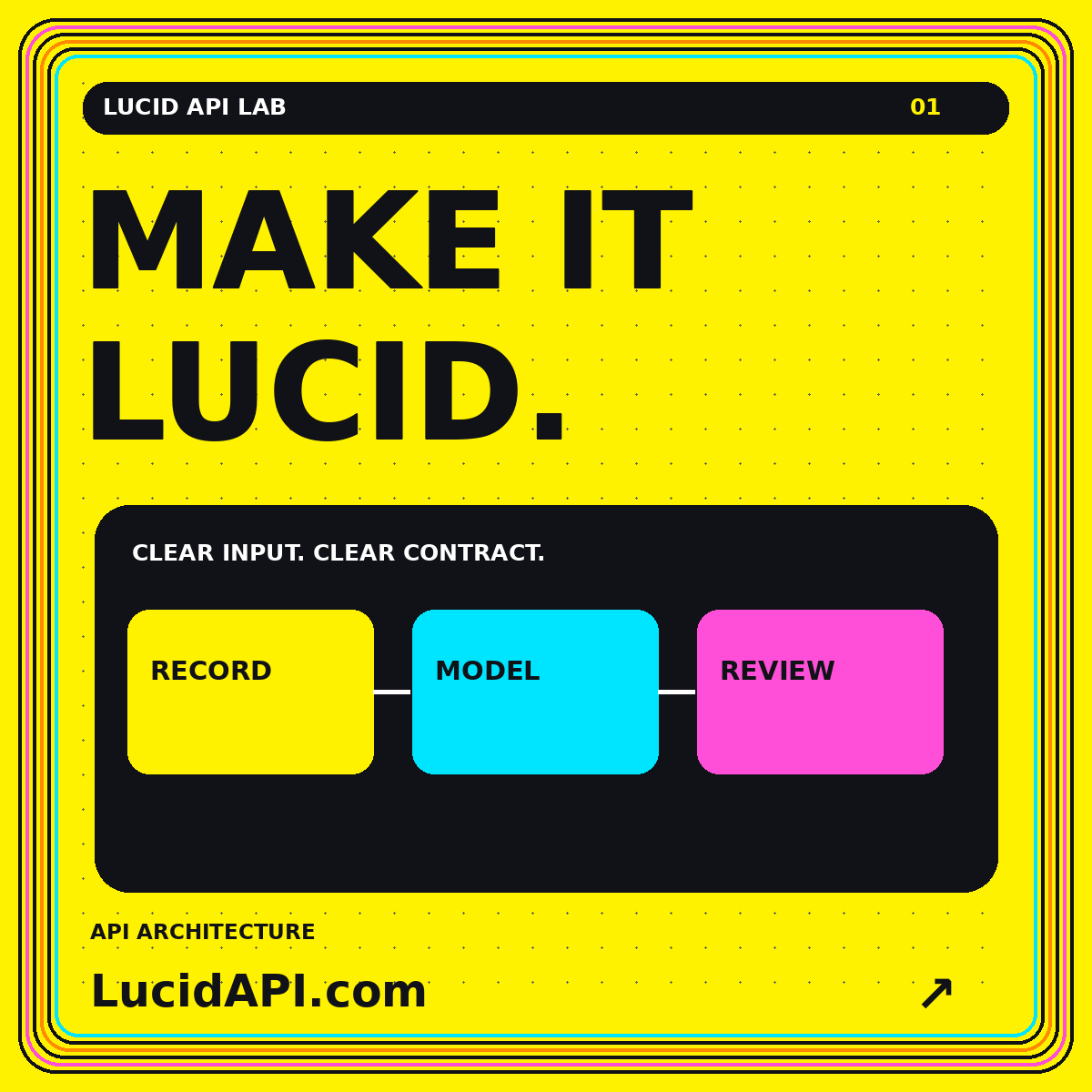
A practical starting point for separating dream records, AI transformations, and agent actions into an understandable API.
01 / THE FOUNDATION
A practical starting point for developers connecting dream records, AI transformations, and agent workflows. Make the interface understandable before making it intelligent.
Name the resource
Define the boundary
Test the failure
The Lucid API topic is the foundation of this resource library. It covers how an application accepts information, authorizes access, performs an operation, and returns a result. The examples are proposed architecture patterns for your own implementation, not endpoints hosted by LucidAPI.com.
Begin with a narrow promise. Saving a journal entry, generating an optional summary, and assembling a private collection are separate operations. Document the owner of each resource and the meaning of each response. A frontend developer should be able to explain what remains available when processing fails without reading a provider's internal error logs.
The record layer preserves a person's original account and its revisions. The transformation layer creates summaries or extracted labels linked to a specific source revision. The workflow layer coordinates permitted actions and records what happened. They may share an application early on, but they should not share an ambiguous definition of success.
For example, saving an entry can succeed even when its optional summary fails. A corrected entry can remain valid while an old summary becomes stale. A cancelled workflow should not remove the underlying account. Treat these as contract decisions rather than interface details to resolve after deployment.
Take one synthetic record from authorized submission through validation, optional processing, review, export, and deletion. Include an invalid request and an unauthorized caller. This small path exposes whether the contract actually connects all of its intended boundaries. Expand only after its states are clear.
Document invalid input, missing authorization, exceeded limits, unavailable providers, and uncertain timeouts. Give clients stable error categories and a defined recovery path. Repeating a request is safe only under the receiving system's actual contract; a client timeout does not establish that work never started.
Version the public data contract separately from model and prompt configurations. A field rename and a model change have different consequences. Preserve enough information to identify which contract, source revision, and transformation produced a result, then test changes against known examples.
Move to Lucid Dream API for journal records and uncertainty. Use Lucid AI API for the inference boundary and operational recovery. Explore Lucid Agent Models when the workflow needs tools or model-directed decisions rather than one fixed transformation.
Do not interpret a diagram, schema, or example request as proof of a deployed service. A production implementation needs actual infrastructure, operational ownership, authorization, and tested behavior. Here, the goal is to make those decisions easier to see before they become dependencies in someone else's application.
FROM THE LUCID API LAB
A practical starting point for separating dream records, AI transformations, and agent actions into an understandable API.
Design a recoverable model-integration boundary with bounded retries, explicit job states, output validation, and useful telemetry.
Build a layered test suite that checks schema meaning, ownership, model adapters, asynchronous state, and user-visible outcomes.