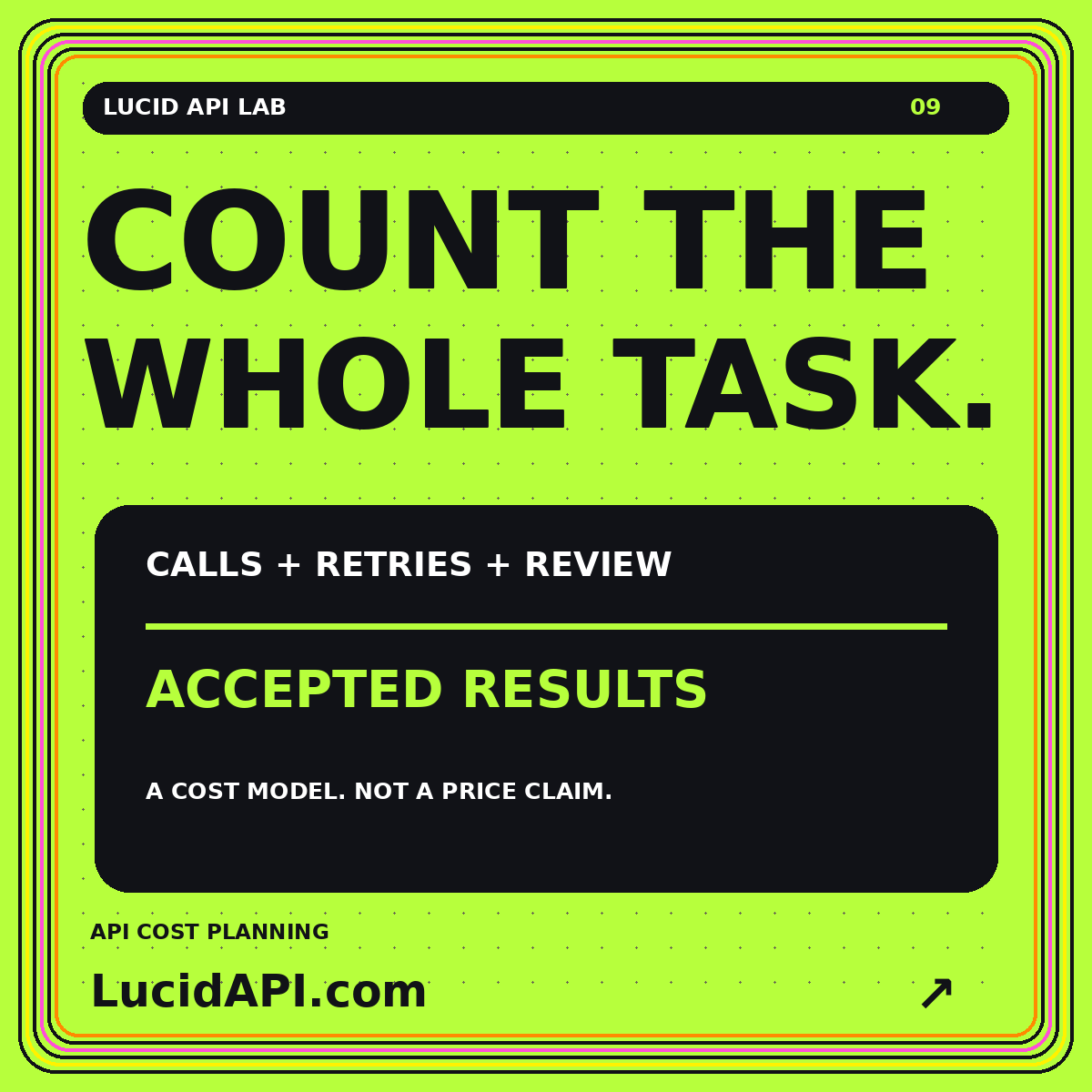
A model's advertised token price is only one input to an application budget. A user operation can involve multiple calls, retries, validation, storage, and optional human review. For a Lucid AI API workflow, the useful question is what it costs to deliver an accepted result under the product's quality and permission requirements. A cheap response that must be discarded still consumes resources.
This guide uses hypothetical numbers to explain the arithmetic. They are not LucidAPI.com prices, provider quotations, current market averages, or a forecast. LucidAPI.com does not sell inference through this static reference site. Replace every assumption with verified rates and measured workload data before making an operational budget or comparing implementation options.
Choose a unit that corresponds to user value
The FinOps Foundation's Unit Economics capability describes connecting technology costs to meaningful units of business value. Applied to a journal feature, a useful unit might be an accepted summary or a reviewed draft collection. The unit should represent the outcome you intend to deliver, not merely the activity that is easiest to count.
Define accepted precisely. For a summary, it might mean a structurally valid result that passes the application's grounding checks. Keep user rejection and technical rejection distinguishable. If the denominator excludes every unsuccessful attempt while the numerator also ignores their cost, the reported unit cost will hide waste. Charge failed attempts to the workload that created them even when no user-visible result was produced.
Separate variable and fixed costs
Variable costs change with activity: billable model input and output, paid tool calls, and usage-based storage or transfer. Fixed or shared costs may include hosting commitments, monitoring, and engineering support. Some costs sit between these categories, such as a service tier that changes in steps when usage crosses a threshold.
Keep the categories visible in the budget. A direct inference estimate is useful, but label it as direct inference rather than total cost. Decide how shared costs are allocated and document the rule. An allocation can be a planning convention without being a physical measurement. Changing the convention should not look like an improvement in the efficiency of the underlying workflow.
Write the per-attempt formula
For text inference priced per million tokens, the simple formula is input tokens multiplied by the input rate, plus output tokens multiplied by the output rate, with each token quantity divided by one million. Add other billable components separately when the provider's actual pricing structure requires them.
A hypothetical per-attempt calculation
Imagine an attempt using 2,000 input tokens and 300 output tokens. Suppose the hypothetical rates are $1 per million input tokens and $4 per million output tokens. The input component is $0.002 and the output component is $0.0012, giving $0.0032 for that attempt. Those figures illustrate units and arithmetic only. They deliberately do not identify or imply the price of a real service.
Convert attempts into a workload estimate
Suppose a hypothetical month contains 10,000 logical summary requests and an observed average of 1.1 billable attempts per request. Under the simplified assumption that every attempt uses the same token quantities, that becomes 11,000 attempts and $35.20 of direct inference. If 9,000 requests produce accepted summaries, direct inference cost per accepted summary is approximately $0.00391.
Real attempts may differ in length and price. A retry could include a larger prompt or a repair instruction, so do not use the simplified average blindly. Sum measured billable usage when it is available. Keep accepted-result counts from the application rather than inferring them from the provider's successful-call count. A successful call can still fail the application's content validation.
Model context growth in multi-step tasks
An agent workflow may carry earlier messages and tool results into later calls. Estimate each step rather than multiplying the first call's cost by the number of steps. A final synthesis operation might receive much more context than an initial routing decision. The same workflow can also branch into different numbers of calls depending on what the task requires.
For a proposed draft-collection assistant, describe a typical route and a bounded worst-case route. Count authorized entries, retrieval results, generation steps, validation repairs, and allowed retries. Use the bounded-agent guide to define stopping rules before estimating the long tail. A budget is easier to enforce when the workflow has a finite set of permitted operations.
Include quality review without hiding its assumptions
If some outputs require human review, record the reviewed fraction, average review time, and the assumed cost of that time. For example, a hypothetical 500 reviews taking two minutes each represent 1,000 minutes, or roughly 16.7 hours. The conversion is straightforward; the appropriate hourly cost depends on the organization and is not supplied by this article.
Do not assume review can disappear merely because a model changes. Re-evaluate the acceptance rubric and observed failure cases. A lower inference price may be offset by more review or regeneration. Conversely, a more expensive configuration may reduce those costs in a particular measured task. Compare complete observed outcomes, not a universal claim that the larger or smaller model is always more economical.
Treat caching as a constrained design choice
A cache can avoid repeated work when the same authorized source revision and transformation configuration recur. Define the cache key using the information that determines the result, including source revision, task, and relevant configuration. An old summary should not be reused for a changed entry just because the visible title remains the same.
Also enforce access control when retrieving cached results. Content equality does not automatically mean two users are allowed to share a cached artifact. Include deletion and permission changes in the cache lifecycle. Estimate savings only after measuring legitimate reuse. A hypothetical cache-hit percentage is a scenario assumption, not a benefit your application has already achieved.
Build scenarios around workload behavior
Create a low, expected, and high usage case using explicit assumptions about request counts, input lengths, attempts, and accepted-result rates. Change a small number of meaningful variables at a time so the cause of the difference remains understandable. A scenario is not a prediction; it is a way to see which assumptions have the largest effect.
Pay attention to unusually long tasks rather than only the average. A small number of unbounded workflows can consume a disproportionate share of a budget in a proposed system. Set per-task limits and observe the distribution of actual usage. Do not invent a population percentile when you have only a few sample runs. Report the size and limitations of the sample alongside the estimate.
Reconcile estimates with actual operations
Compare the application's request ledger with provider usage records and the eventual bill. Differences can come from time boundaries, failed attempts that remain billable, model-rate changes, or missing telemetry. Investigate the difference instead of forcing every invoice into the original estimate. Keep the version and date of the rates used in the budget.
A useful ledger records logical request identity, attempts, configuration, measured or estimated usage, terminal state, and accepted outcome. Avoid logging journal text merely for cost analysis. Aggregate by task and configuration where possible. The reliable integration article describes the request identities and attempt tracking that make this reconciliation practical without collecting unnecessary content.
Conclusion: cost clarity comes from a clear workflow
The useful cost of a Lucid AI API feature is the cost of its complete accepted outcome under stated assumptions. Token arithmetic matters, but so do failed attempts, context growth, review, shared infrastructure, and the work that never reaches an acceptable result. A transparent estimate shows those components rather than hiding them behind a single attractive number.
Start with one defined task and measured sample runs. Keep hypothetical scenarios separate from observed usage, verify actual rates, and enforce bounded execution before expanding an agent workflow. The Lucid AI Model guide helps connect quality requirements to configuration choices, so cost optimization does not quietly change what the product promises to deliver.